Fire water storage tanks provide a dedicated water supply when a building’s fire protection system needs it most. However, choosing the right tank capacity requires more than estimating how much water a building might use.
A small commercial building may have different fire water requirements than a large warehouse or manufacturing facility. Even buildings of similar sizes can need different storage capacities.
The right tank size depends on water demand, supply duration, available water sources, and fire protection requirements. Understanding these factors helps building owners and facility managers make informed decisions before installing a fire water storage system.
This guide explains fire water tank sizing, basic calculations, and common planning mistakes without complicated engineering terminology.
What is Fire Water Tank Sizing?
Fire water tank sizing is the process of determining how much water a tank must store for fire protection. The goal is to provide enough usable water for the required firefighting operations. Unlike everyday water storage, fire protection systems must deliver water at specific flow rates for a defined period.
A tank must support these demands without running out of usable water too early. For example, a warehouse sprinkler system may need a continuous water supply during a fire. The required volume depends on how much water the system uses and how long that supply must continue.
Several terms are useful when discussing fire water tank capacity:
-
Tank capacity: The total volume a tank can hold.
-
Usable water capacity: The amount of water available to the fire protection system.
-
Flow rate: The amount of water delivered each minute, usually measured in gallons per minute (GPM).
-
Supply duration: The period during which the system must receive the required water flow.
These measurements help determine whether a proposed tank can support a building’s fire protection needs. Importantly, a tank’s advertised capacity does not always equal the amount of water available for firefighting.
Some water may remain below the usable outlet level or become unavailable due to system limitations. Therefore, fire water tank sizing should focus on usable capacity rather than total storage volume alone.
Understanding these requirements helps facility managers evaluate fire water storage tanks for different commercial and industrial applications.
Key Factors That Determine Fire Water Tank Capacity
There is no single fire water tank size suitable for every commercial or industrial building. Several factors influence how much water a facility needs to store.
1. Building Type and Fire Risk
The activities inside a building influence its fire protection requirements. An office building generally presents different fire hazards than a warehouse storing combustible materials.
Similarly, a manufacturing facility may contain equipment, chemicals, or processes that require additional protection.
Common building types include:
-
Commercial offices and retail facilities.
-
Warehouses and distribution centers.
-
Manufacturing and industrial plants.
-
Food processing facilities.
-
Large storage and logistics buildings.
However, building type alone does not determine the required tank capacity. The materials stored, building layout, and installed protection systems also influence water demand. For example, two warehouses may have identical floor areas but different storage arrangements.
One might contain ordinary packaged products, while another stores large quantities of combustible materials. Their sprinkler system requirements could differ significantly.
2. Required Fire Water Flow Rate
Flow rate describes how much water a fire protection system needs each minute. In the United States, this measurement is usually expressed in gallons per minute (GPM). A system requiring 500 GPM uses 500 gallons of water every minute while operating at that rate.
Higher flow rates generally require larger water supplies when the required operating duration remains unchanged. However, the appropriate flow rate must come from the facility’s fire protection design.
It should not be selected using a general estimate.
3. Required Water Supply Duration
Fire protection systems must maintain an adequate water supply for a specified period. This period is known as the required water supply duration.
Depending on the applicable design requirements, the duration may vary considerably between facilities. For illustration, consider two systems with identical flow rates:
| System | Flow rate | Duration | Water volume |
|---|---|---|---|
| Example A | 500 GPM | 60 minutes | 30,000 gallons |
| Example B | 500 GPM | 90 minutes | 45,000 gallons |
These examples demonstrate how operating duration affects total water demand. They are not recommended design requirements for any particular building.
A longer required duration increases storage demand unless another approved water source contributes to the supply.
4. Available Municipal Water Supply
Some commercial buildings receive sufficient fire protection water from a municipal supply. Others require dedicated storage because the public supply cannot meet their system’s demands.
Water availability may depend on:
-
Local water infrastructure.
-
Available flow and pressure.
-
Municipal supply limitations.
-
Reliability of the water source.
-
Applicable fire protection requirements.
A reliable municipal supply may reduce the amount of dedicated storage needed. However, its contribution must be established through appropriate testing and system design.
Building owners should not assume that a nearby water main can support the required firefighting flow.
5. Multiple Fire Protection Systems
Some facilities use several fire protection systems. These may include automatic sprinklers, standpipes, hose connections, or specialized protection equipment. Depending on the design, multiple demands may need to be considered together.
For example, a sprinkler system may require additional water for a specified hose stream allowance. However, these demands cannot simply be added together in every situation.
The applicable standards determine which flows must operate simultaneously. This is particularly important for industrial facilities with complex fire protection arrangements.
Fire Water Storage Tank Sizing Requirements and NFPA Standards
Fire water storage requirements in the United States are influenced by several National Fire Protection Association standards. These standards address different parts of a fire protection system.
Understanding their general purposes helps explain how tank capacity is determined.
NFPA 22: Water Storage Tanks for Fire Protection
NFPA 22 addresses water tanks used for private fire protection. It covers important aspects of tank design, construction, installation, and water supply arrangements.
However, NFPA 22 does not establish one universal storage capacity for every building. The required water volume depends on the fire protection system’s demands and applicable requirements.
NFPA 13: Sprinkler System Requirements
NFPA 13 addresses the installation and design of automatic sprinkler systems. Sprinkler system design helps establish the required water flow and supply duration.
These values are important inputs when determining fire water storage capacity. Different hazards and sprinkler arrangements can produce different water demands.
NFPA 14: Standpipe Systems
NFPA 14 covers standpipe and hose systems used for firefighting. These systems may require substantial water flow during emergency operations.
Their requirements can influence the overall water supply design.
NFPA 20: Fire Pumps
NFPA 20 addresses the installation of stationary pumps for fire protection. Fire pumps help deliver water at the pressure and flow required by the protection system.
However, a pump does not replace the need for an adequate water source. A large pump cannot compensate for insufficient available water volume.
Why Local Requirements Matter
National standards provide important guidance, but local requirements must also be considered. Applicable rules may depend on the building’s location, occupancy, and adopted code editions.
The local Authority Having Jurisdiction (AHJ) may review or approve the proposed fire protection arrangements. For this reason, preliminary tank calculations should never replace a qualified fire protection design.
Understanding fire water tank regulatory requirements helps facility managers recognize how applicable standards influence storage planning.
How to Calculate Fire Water Tank Capacity
The basic calculation for fire water storage is straightforward.
You need two main values:
-
The required water flow rate.
-
The required supply duration.
Once these values are established, they can be multiplied to estimate the required water volume.
Basic Fire Water Tank Sizing Formula
Water Volume = Flow Rate × Duration
Water Volume = gallons
Flow Rate = gallons per minute (GPM)
Duration = minutes
For example, suppose a fire protection system requires 400 GPM for 60 minutes.
The calculation would be:
400 GPM × 60 minutes = 24,000 gallons.
This means the system requires 24,000 gallons of water during the specified period. However, this number represents the calculated water demand, not necessarily the final tank size.
Additional factors may affect the required storage capacity.
Accounting for Usable Water Capacity
Not every gallon inside a storage tank is necessarily available to the fire protection system. Some water may remain below the usable suction level. The tank’s outlet arrangement, minimum operating water level, and other design considerations can affect available capacity.
For example, a tank holding 30,000 gallons may provide less than 30,000 gallons of usable water. The difference depends on the actual tank configuration.
Therefore, the selected tank must provide the required usable volume. Its nominal capacity may need to be larger than the calculated water demand.
Considering Other Water Sources
A fire protection system may receive water from both a storage tank and another approved source. In some designs, a reliable municipal supply contributes part of the required flow. This can affect the storage volume needed.
However, the available contribution must be verified under the applicable design conditions. A simplified calculation should not automatically subtract municipal water without considering pressure, reliability, and system requirements.
Fire Water Tank Sizing Example for a Commercial Facility
A practical example makes fire water storage calculations easier to understand. Consider a hypothetical commercial warehouse with an automatic sprinkler system.
Assume its approved design establishes the following requirements:
| Parameter | Example Value |
|---|---|
| Building type | Commercial warehouse |
| Required water flow rate | 500 GPM |
| Required water supply duration | 60 minutes |
| Calculation | 500 GPM × 60 minutes |
| Total calculated water demand | 30,000 gallons |
Note: These values are hypothetical and provided for educational purposes only. Actual fire water storage requirements depend on the facility’s fire protection design and applicable standards.
Step 1: Identify the Required Flow Rate
The first step is determining the water flow required by the fire protection system. In this example, the design flow is 500 GPM.
This value is assumed to come from an approved system design.
Step 2: Confirm the Required Duration
Next, identify how long the system must maintain that flow. For this example, the duration is 60 minutes.
The actual duration for a real facility may be different.
Step 3: Calculate Total Water Demand
Multiply the flow rate by the duration. 500 × 60 = 30,000 gallons.
The calculated demand is therefore 30,000 gallons.
Step 4: Check Available Storage Capacity
The next step is confirming whether the proposed tank can deliver the full required volume. A tank with a nominal capacity of 30,000 gallons may not provide 30,000 usable gallons.
For example, some stored water may remain below the minimum usable level. The tank’s configuration must account for this difference.
Step 5: Review the Complete Water Supply
Finally, the tank must be considered alongside the entire fire protection system. This includes pumps, piping, water sources, and applicable design requirements.
The final tank selection should be confirmed by a qualified fire protection professional.
How Tank Dimensions Affect Available Fire Water Storage
Tank capacity is usually expressed in gallons, but physical dimensions also matter. Two tanks can hold similar volumes while having different shapes and installation requirements.
The available site space often influences the tank configuration.
Tank Height and Diameter
For cylindrical tanks, both height and diameter affect total storage volume. A wider tank can store more water without requiring the same height as a narrower tank.
Similarly, a taller tank may provide greater capacity within a smaller footprint. However, the most suitable dimensions depend on more than available space.
The tank must also meet structural, operational, and fire protection requirements.
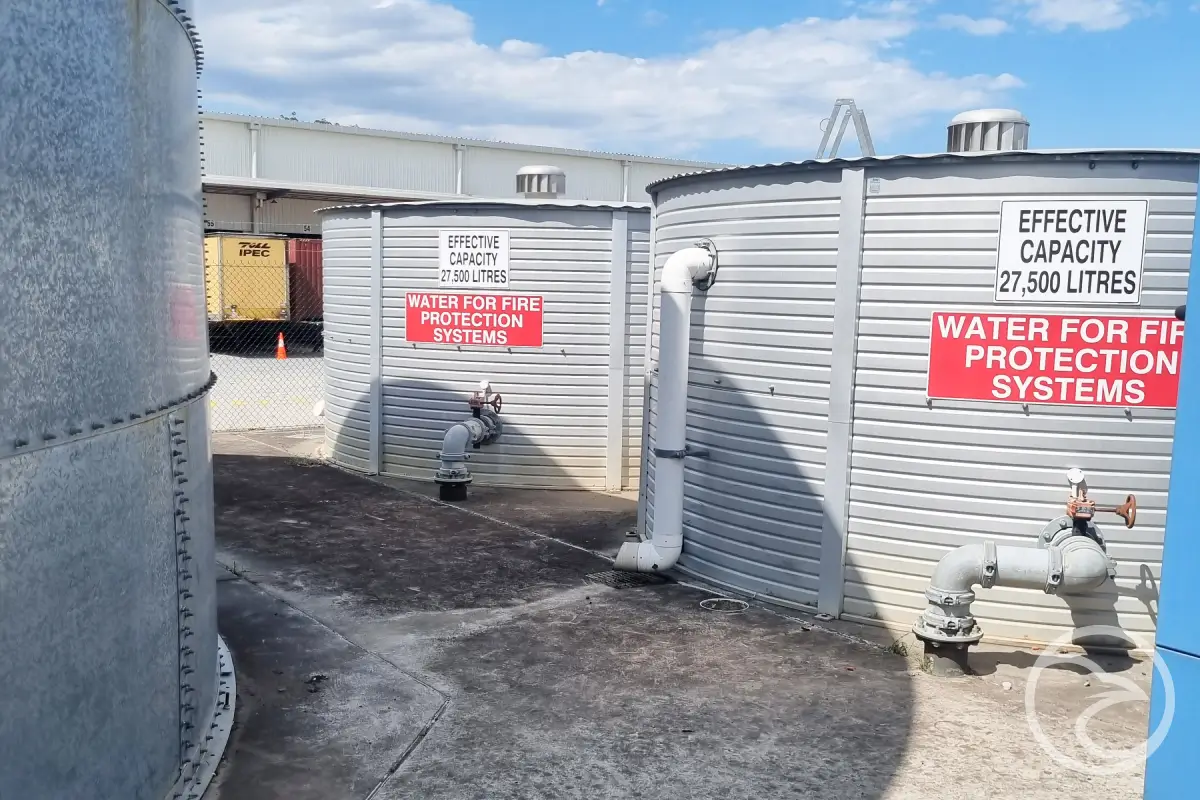
Cylindrical and Rectangular Tanks
Fire water storage tanks are available in different configurations. Cylindrical tanks are common in many outdoor installations.
Rectangular tanks may be considered where available space or building layouts create restrictions. The appropriate configuration depends on the project.
Neither shape automatically provides a better fire protection solution.
Minimum Usable Water Level
Tank dimensions also influence how much stored water remains available during operation. The location of outlets and suction connections affects usable storage.
Water below the minimum usable level may not contribute to the required supply. Therefore, calculating the tank’s physical volume is only part of the sizing process.
The available operating volume must also be verified.
Installation Space
A proposed tank must fit safely within the available site.
Planning considerations may include:
-
Available ground area.
-
Tank height restrictions.
-
Access for installation and maintenance.
-
Foundation requirements.
-
Connections to the fire protection system.
These factors may influence the final tank dimensions without changing the required usable water volume.
Common Fire Water Tank Sizing Mistakes
Fire water storage planning can become complicated when important details are overlooked. Several common mistakes can lead to incorrect capacity estimates.
1. Choosing Capacity Based Only on Building Size
A large building does not automatically require a specific tank volume. Fire hazards, sprinkler design, and other protection requirements influence water demand.
Two similarly sized facilities may need different storage capacities.
2. Confusing Total Capacity with Usable Capacity
A tank’s nominal capacity does not always represent the water available for firefighting. Selecting a tank without checking usable volume may leave the system with insufficient storage.
3. Ignoring Water Supply Duration
Flow rate alone cannot determine the required storage volume. The duration of the required water supply is equally important.
Even a moderate flow rate can require substantial storage when maintained for an extended period.
4. Assuming Municipal Water Is Always Sufficient
A public water connection does not guarantee adequate firefighting water. Available pressure and flow must be verified.
Municipal supply limitations can influence whether dedicated storage is necessary.
5. Overlooking Combined Water Demands
Some systems must account for more than one water demand. Ignoring required simultaneous flows may underestimate total water requirements.
However, combining demands incorrectly can also produce misleading calculations.
6. Treating Example Calculations as Design Requirements
Online examples are useful for understanding basic calculations. However, they cannot establish the correct capacity for every facility.
Real fire water tank sizing requires project-specific information and applicable design standards.
Final Considerations for Fire Water Storage Planning
Correct fire water tank sizing begins with understanding how much water a facility’s fire protection system requires. Flow rate, supply duration, fire hazards, and available water sources all influence the required storage volume.
The basic calculation is simple, but the final tank selection involves additional considerations. Usable water capacity, tank dimensions, and applicable NFPA requirements must also be reviewed.
For commercial and industrial facilities, accurate planning helps ensure the required water supply is available during an emergency. A qualified fire protection professional should confirm the final capacity before installation.